INTAKE
One brief defines the request, location, and occasion. Each model receives the same context.
I wanted to see how much ChatGPT, Gemini, and Claude agree—and where they take the same question in different directions. Could I make those differences easy to see?
Consensus gives all three the same brief independently, then lines up their answers so the overlap and disagreement become visible. Food was the first test case: subjective, familiar, and easy to judge.
It started as a native SwiftUI app—an experiment in learning the Apple ecosystem. The public web version came later.
TRY IT LIVE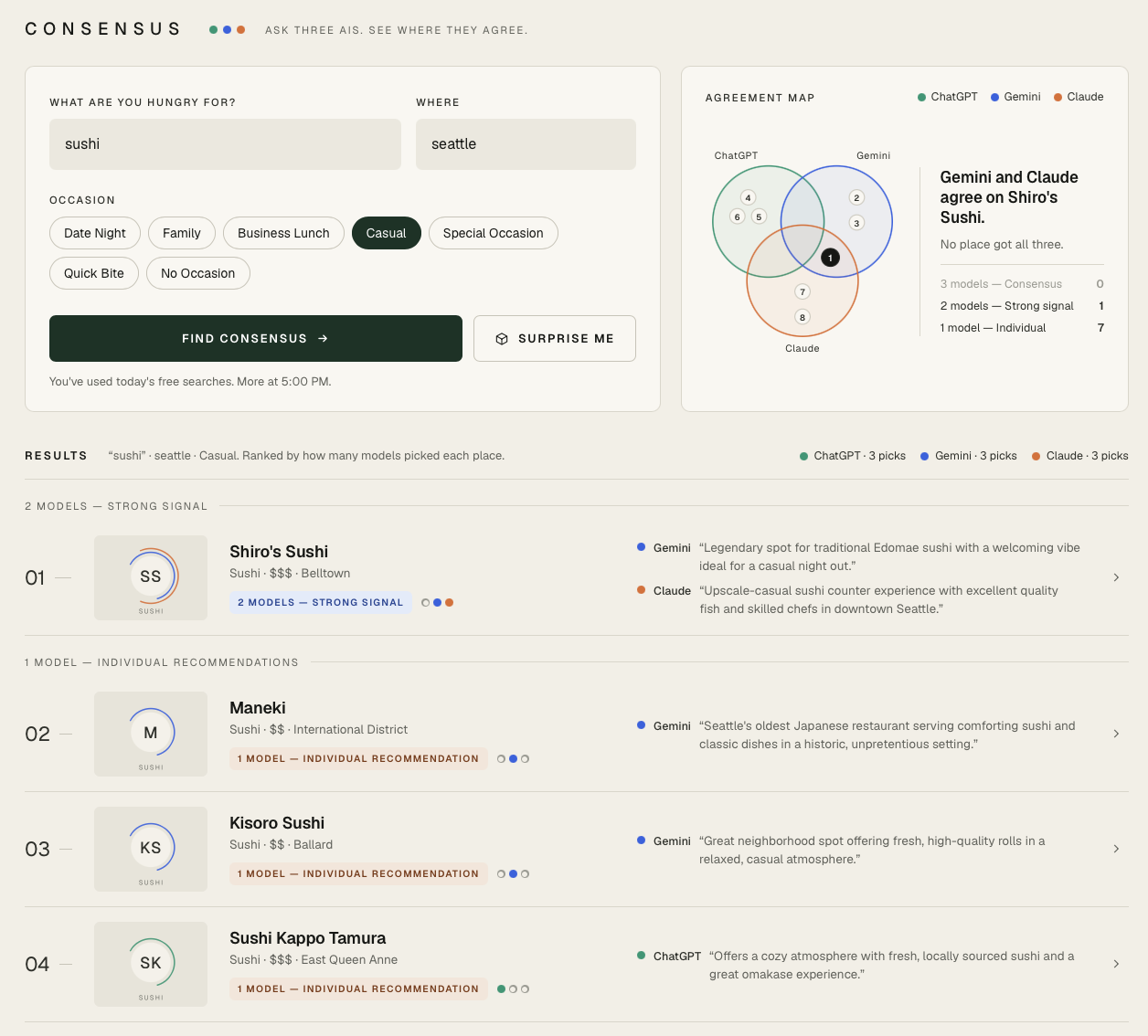
One model can recommend a restaurant with the confidence of someone who has a reservation there tonight. It may never have checked whether the place is open. I wanted three independent answers side by side, including the odd one out.
Agreement is useful. So is seeing exactly why one model disagreed.
One brief defines the request, location, and occasion. Each model receives the same context.
ChatGPT, Gemini, and Claude answer simultaneously, without seeing one another’s picks. Each returns a restaurant, cuisine, price, neighborhood, rationale, and confidence.
Names are cleaned before comparison. “Zuni Café” and “Zuni Cafe” should count as the same place.
Recommendations are grouped by model agreement. The interface keeps each model’s reasoning visible, including lone picks.
All three independently surface the same place.
Two align; one takes another position.
A minority pick stays visible. Sometimes it is the most interesting recommendation.
I thought the three-way match would be the product. It turns out the dissenting pick is often the interesting one.
Consensus marks the overlap, but leaves the minority opinion and its reasoning on the table.
ChatGPT answered. Claude answered. Gemini returned an empty column. I added a fallback path: adjust its thinking budget, retry when overloaded, then use a lighter model if needed.
The incomplete result had also been cached. One temporary failure could have been served repeatedly for 24 hours. The rule became simple: only cache complete results.
Public use also required server-side API keys, five searches per visitor per day, a global request ceiling, token limits, and caching repeated searches. Those constraints are part of the product design.
Three smart contributors do not automatically make a team. You still need one brief, comparable outputs, a way to handle exceptions, and someone willing to make the call.
For two decades, I built creative systems around brief →︎ resource →︎ execution →︎ review →︎ decision →︎ delivery. Consensus applies the same logic to prompt →︎ models →︎ structured output →︎ normalization →︎ comparison →︎ decision.
That was my job for years with people. Here I got to see what changed when the contributors were models.